


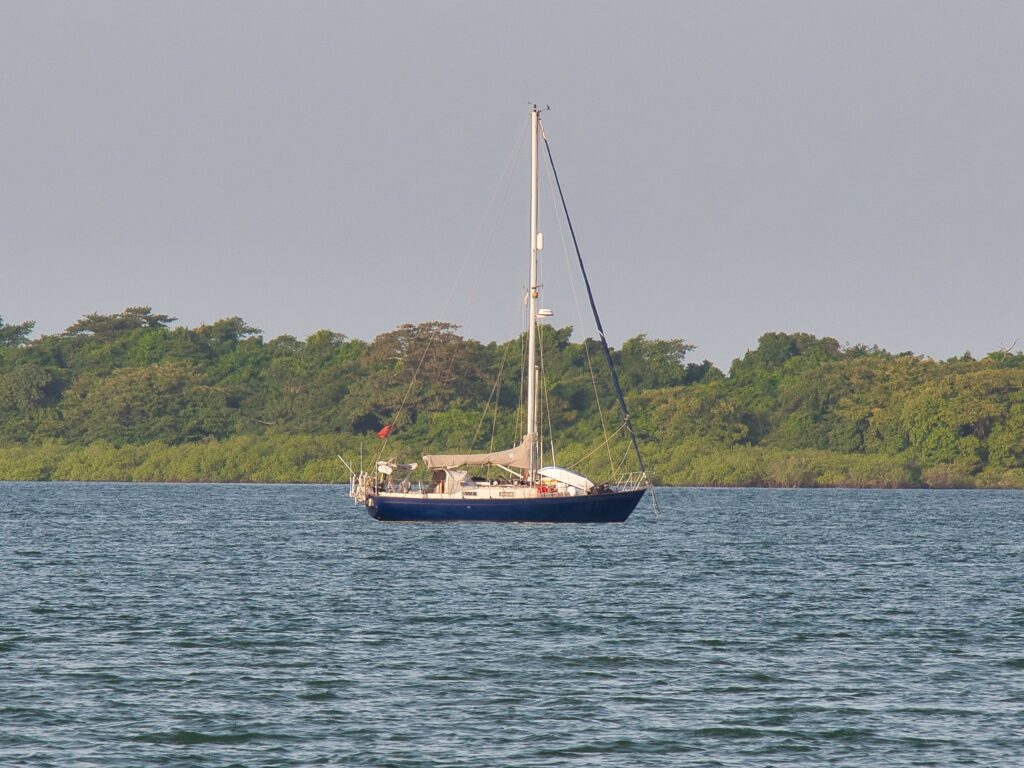
Increasingly, YouTube sailors no longer seem to be simply setting out on a cruise or, to put it simply, a trip. Rather, they are embarking on a veritable ‘expedition’. They refer to their yachts accordingly as expedition vessels. Often these are indeed sturdy aluminium constructions that would likely be capable of withstanding extreme conditions. But does a journey undertaken on an aluminium boat with a watertight companionway hatch automatically make it an expedition?
Missing gaps
What is an expedition anyway? The dictionary defines an expedition, derived from the Latin expeditio, meaning ‘military campaign’ (sic), as a research or discovery voyage, whereby, naturally, the area or subject to be explored exerts its appeal on the explorers as a gap in knowledge. Geographically, unexplored areas have, as we know, become rare on our Earth. What remains are scientific gaps to which one might devote oneself – or the hunt for the Earth’s treasures, which so-called ‘progressive’ technology demands.
All in all. It actually doesn’t seem all that easy to go on an expedition these days. So where does this inflation of the term come from in the scene of sailing globetrotters?
My ‘expeditions’
Admittedly: I too have, in connection with a more or less mundane voyage – a voyage into a well-mapped area without icebergs or monsters – spoken of an expedition on occasion, even though Blue Alligator can hardly be described as an expedition vessel in good conscience. Although I can immediately think of a few boats which – by no means more solid or better equipped than my Victoria 34 – have been underway in conditions worthy of an expedition. One of my favourite examples is ‘Dodo’s Delight’, a Westerly Discus, 33 feet long and also somewhat past its prime. Reverend Captain Bob Shepton, born in 1935, sailed her – at an age when others are pushing their walkers to the shops – through the Greenlandic fjords, amongst other places. On board was a group of professional climbers who not only scaled icy peaks but also got up to a lot of fun nonsense. Among other things, they composed a proper sea shanty and even produced a music video to go with it, which I warmly recommend to any lover of seafaring and which paid a fitting tribute to the good little boat and its skipper.
But I digress. My ‘expedition’ took me back then to the Ilhas Selvagens, a few barren rocks between Madeira and the Canary Islands, inhabited by birds, lizards and a couple of park rangers. Actually, it wasn’t my expedition at all. I was basically just the skipper and Blue Alligator the transport vessel.
It was my companions’ expedition; they were the ones who wanted to go diving there. And in truth, they were by no means the first to do so, which is why using the term was rather presumptuous.
Not much came of it. Not even a song. We could at least have gone in search of the treasure of the legendary Captain Kidd, which is said to be hidden on the island. That, at the very least, would have been worthy of an expedition.
The Bijagos Expedition
When I later sailed to the Bijagos in a flotilla of six boats, some of the participants also spoke of an ‘expedition’. Having a somewhat more critical view of the term, it struck me as a bit too grandiose. Yet the archipelago off the coast of Guinea-Bissau is one of the more unexplored ‘cruising grounds’ on earth.
But neither were we shot at with arrows by the islanders, as is said to have happened to the Portuguese explorers in the 15th century – only an angry fisherman hurled an iron bar onto one of the boats – nor did we feel our way through the labyrinth of islands and sandbanks with the aid of depth sounders and lookouts, as befits true explorers. The electronic nautical charts were almost outrageously accurate for this area. It was anyone’s own fault if they ran aground there.
Our trials and tribulations – compare this with accounts of the exploration of the Northwest Passage or, for those who prefer something more entertaining, T. C. Boyle’s wonderful novel „Water Music“ about the Scottish explorer Mungo Park’s voyages to the Niger. Our trials, then, were limited to a few beads of sweat, some contaminated diesel and tangled anchor chains. Nothing that couldn’t be washed down with a cold beer in one of the now numerous tourist lodges, where Polish tour groups and Portuguese embassy staff stood in stark contrast to the local population.
The journey into one’s own heart of darkness
But perhaps I am being unfair – to myself and to the many explorers who flood YouTube with their expeditions. Is it not also about pushing one’s own boundaries and exploring the dark corners of one’s inner terrain? Are these not the expeditions that the 21st century has in store for us, who cannot afford space flights?
Seen in this light, even a transatlantic crossing in the comparatively safe convoy of an Atlantic Rally for Cruisers is an expedition, for even on a 50-foot luxury yacht one can discover one’s unknown self in three weeks at sea if the fridge breaks down after just a week. However, this is not far removed from the platitude that life itself is an expedition – into one’s own heart, which is at times as dark as Conrad’s story about Kurz in the Congo.
The nature of linguistic evolution
A dilemma. Terms lose their meaning, and soon ‘expedition’ will come to mean something as banal as a package holiday to Mallorca. Such is the nature of linguistic evolution. Driven, no doubt, by the desire to better market one’s own exploits in the attention economy – in our case, social media – the term is losing its value just like the dollar under Trump.
Speaking of which: another ploy seems to be to present oneself as a novice who knows nothing about boats or navigation, yet sets off on a round-the-world trip anyway. It was not uncommon for earlier adventurers to be reckless, gullible and downright suicidal on their expeditions. Some survived only thanks to a steep learning curve or the mercy of the people who believed they had discovered them. Others died because of their own ignorance (see Franklin and Co). But if the essence of an expedition consists solely of surviving one’s own ignorance, the concept will soon be as hollow as a Kinder surprise egg with no surprise inside.
Amidst all these gloomy thoughts, I watch the video of ‘Dodo’s Delight’ for the umpteenth time and see the little boat sailing past icebergs, rocking in secluded bays and chugging through the waves of the North Atlantic, I see the Reverend, wrapped up in bright yellow oilskins, dozing on the cabin bench, and the merry mountaineers romping about on the mast.
It makes me feel an overwhelming urge to go on an expedition.